
Virginia Strengthens Standards for Youth Parole Decision-Making
Blog by Destiny M. Hibbler-Wiley, Research & Implementation Counsel at the Campaign for the Fair Sentencing of Youth
Many states across the country have taken steps to end extreme sentences for children. In 2021, Virginia did so by establishing parole eligibility for children who were under 18 at the time of their offense after serving 20 years in prison.
But parole eligibility alone is not enough. The critical question remains: what makes parole review meaningful? A new bill in Virginia (SB60/HB318) helps answer that question.
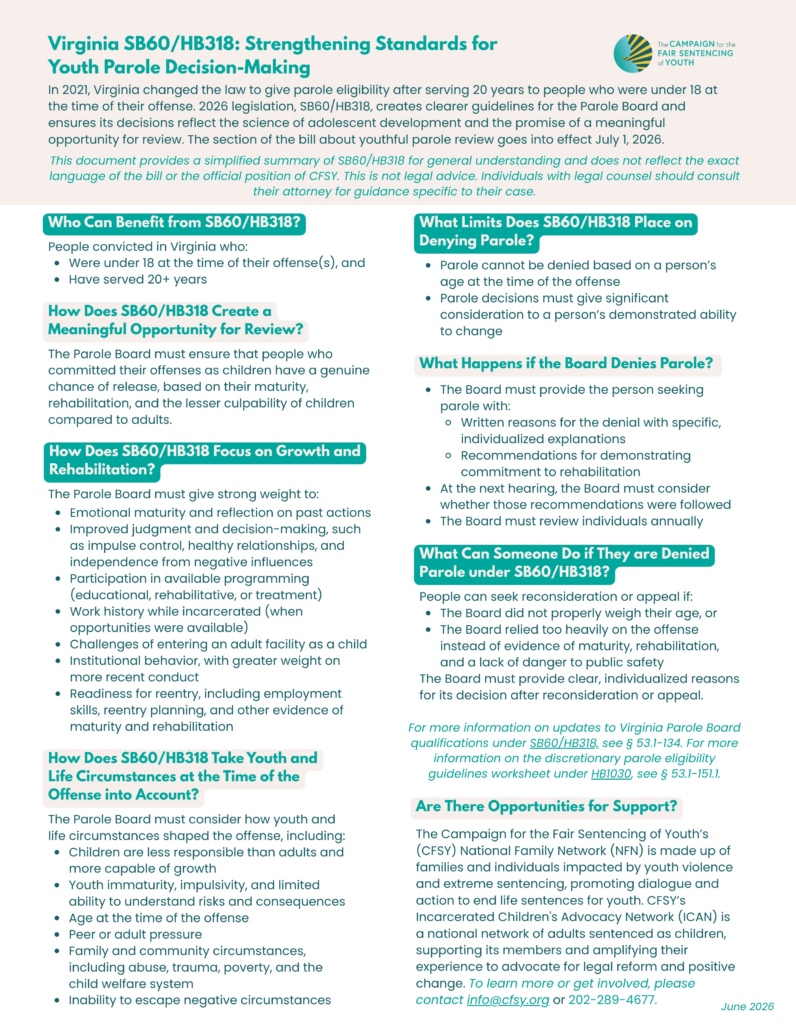
Effective July 1, 2026, the new bill establishes clearer standards for how the Virginia Parole Board evaluates individuals who were sentenced as children–bringing greater structure, transparency, and fairness to the process.
A Framework to Focus on Change
The bill requires the Parole Board to give significant consideration to a person’s ability to change. Research and legal precedent makes clear that children are fundamentally different from adults. Youth are more impulsive, more vulnerable to outside influences, and more capable of growth over time.
SB60/HB318 incorporates these principles into parole decision-making by requiring the Board to:
- Consider demonstrated maturity, rehabilitation, and the recognition that children have lesser culpability; and
- Give strong weight to indicators of growth, including more recent conduct, emotional maturity, improved decision-making, and participation in rehabilitative programming.
This marks an important shift, highlighting that parole decisions must reflect not only an individual’s past actions but also who they have become.
Recognizing Youth and Life Circumstances
SB60/HB318 also requires the Parole Board to consider the role that youth and life circumstances played in the offense.
This includes:
- The developmental characteristics of youth, such as immaturity and limited risk assessment
- The influence of peers or adults
- Family and community conditions, including trauma, poverty, and instability
- The reality that many children could not escape harmful or negative environments
The bill further makes clear that a person’s age at the time of the offense cannot be used against them. These considerations ensure that parole decisions are grounded in a full understanding of the distinct characteristics of childhood and the underlying factors of youth involved in serious harm.
Strengthening Transparency and Accountability
SB60/HB318 also improves the structure of the parole process itself.
If parole is denied, the Board must:
- Provide clear, individualized reasons for its decision
- Offer guidance on how the individual can demonstrate further rehabilitation
- Reconsider progress at future hearings
Individuals are also able to seek reconsideration or appeal if the Board fails to properly consider youth-related factors or relies too heavily on the offense.
Together, these provisions create a more transparent and responsive system–one that gives people a clearer understanding of what is expected and how to move forward.
Why This Matters
Across the country, thousands of people sentenced as children are now eligible for parole review. But without clearer standards, those reviews risk falling short of the “meaningful opportunity for release” required by law.
SB60/HB318 represents an important step toward aligning practices with what we know about youth, growth, and second chances. It reinforces the principle that people are more than the harm they caused as children and that change must be recognized.
For more details, access our resource on SB60/HB318 here.