

By Marshan Allen • July 2, 2026
For me, Miller affirmed something I had always known to be true: I was more than the worst thing I had done at fifteen years old. When I was sentenced, the law treated me as if I were beyond redemption before I had even become an adult. It didn’t matter who I was, what role I played, or who I might become. I was simply condemned to die in prison.
Miller recognized that children are fundamentally different. We are impulsive, vulnerable to outside influences, and still developing. More importantly, we have the capacity to grow and change. That decision didn’t erase the harm caused by the crime, but it restored something that had been taken from me—my humanity. It acknowledged that a child’s life should never be defined by a single moment, no matter how tragic. For me, Miller wasn’t just a legal ruling; it was an affirmation that hope, redemption, and human dignity still have a place in our legal system.
When I was sentenced, no one asked what it meant to be fifteen. No one considered how easily young people can be influenced, how limited our judgment is, or how much we are capable of changing over time. My age wasn’t treated as a mitigating factor—it was treated as aggravating or irrelevant. Miller finally recognized what should have been obvious all along: childhood matters.
The U.S. Supreme Court’s recognition that youth matters validated not only my experience but the experiences of thousands of other children who were condemned under mandatory sentencing laws. It acknowledged that justice requires seeing children as whole human beings, not just through the lens of the worst decision they ever made.
Looking back now, after spending nearly twenty-five years in prison, earning degrees, rebuilding my life, becoming a husband, a leader in criminal legal reform, graduating from law school, and preparing to become an attorney, I am living proof of what the Court recognized in Miller: children have an extraordinary capacity for growth. My story isn’t exceptional because I changed; it’s exceptional only because the legal system finally allowed me to demonstrate the person I was capable of becoming.
The lesson of Miller is that accountability and hope can exist together. We can acknowledge profound harm while still recognizing that no child is beyond the possibility of redemption. That principle changed my life, and it continues to shape the work I do every day to ensure other children are judged not only for who they were, but for who they have the potential to become.
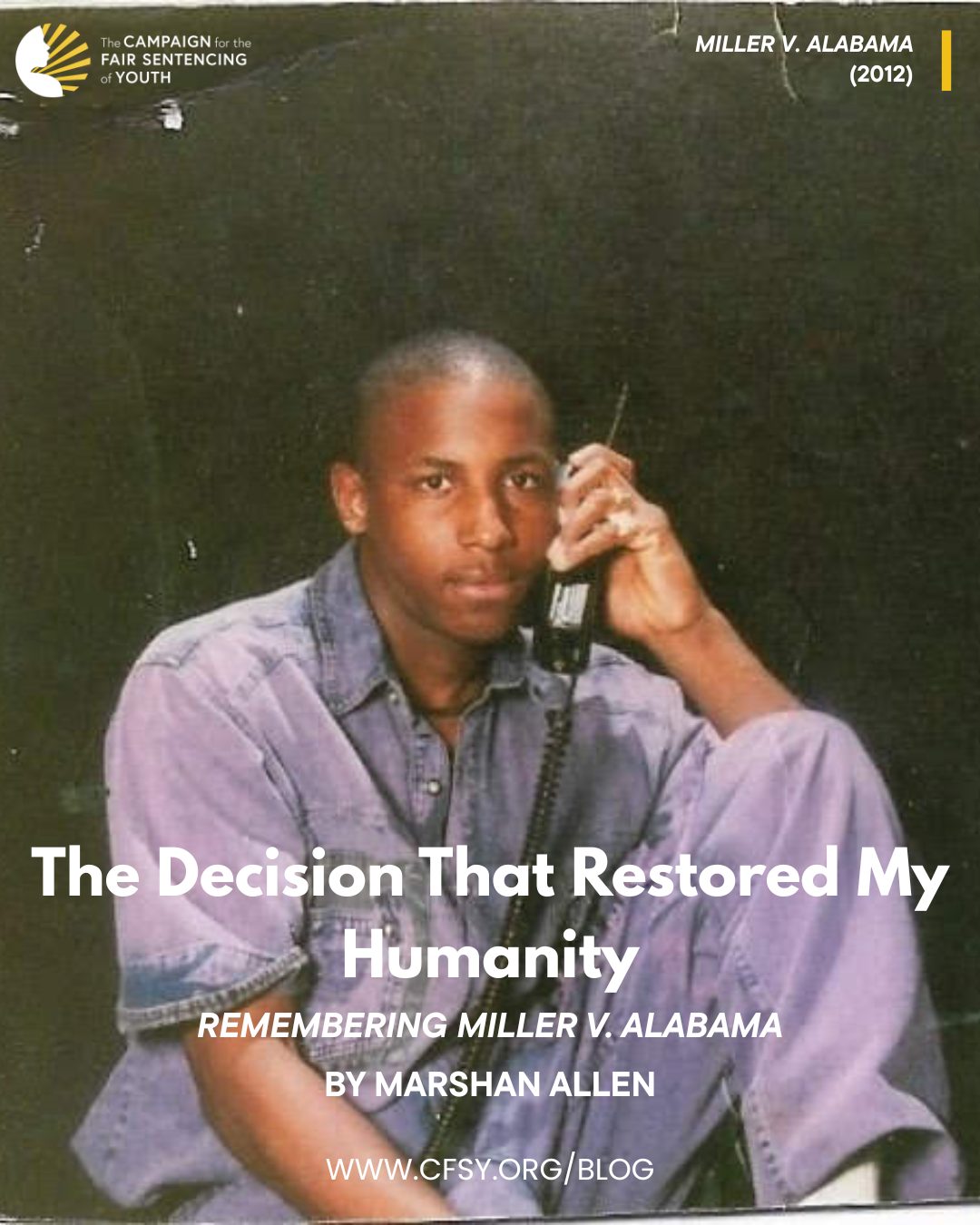
Marshan Allen was sentenced to two counts of mandatory life without parole in Illinois at the age of 15. During his incarceration he became a certified paralegal, and upon his release graduated from Northeastern Illinois University in August 2020 with a Bachelor’s degree in Justice Policy and Advocacy and most recently received his law degree in 2026 from Chicago-Kent College of Law. Marshan is also an alumnus of The Campaign for the Fair Sentencing of Youth (CFSY)’s board of directors and a member of the Incarcerated Children’s Advocacy Network (ICAN).
