Tag Archive for: Press Release

Press Release: Minnesota bans juvenile life without parole - May 2023

MINNESOTA PASSES CRIMINAL JUSTICE OMNIBUS BILL, BANNING LIFE WITHOUT PAROLE FOR CHILDREN

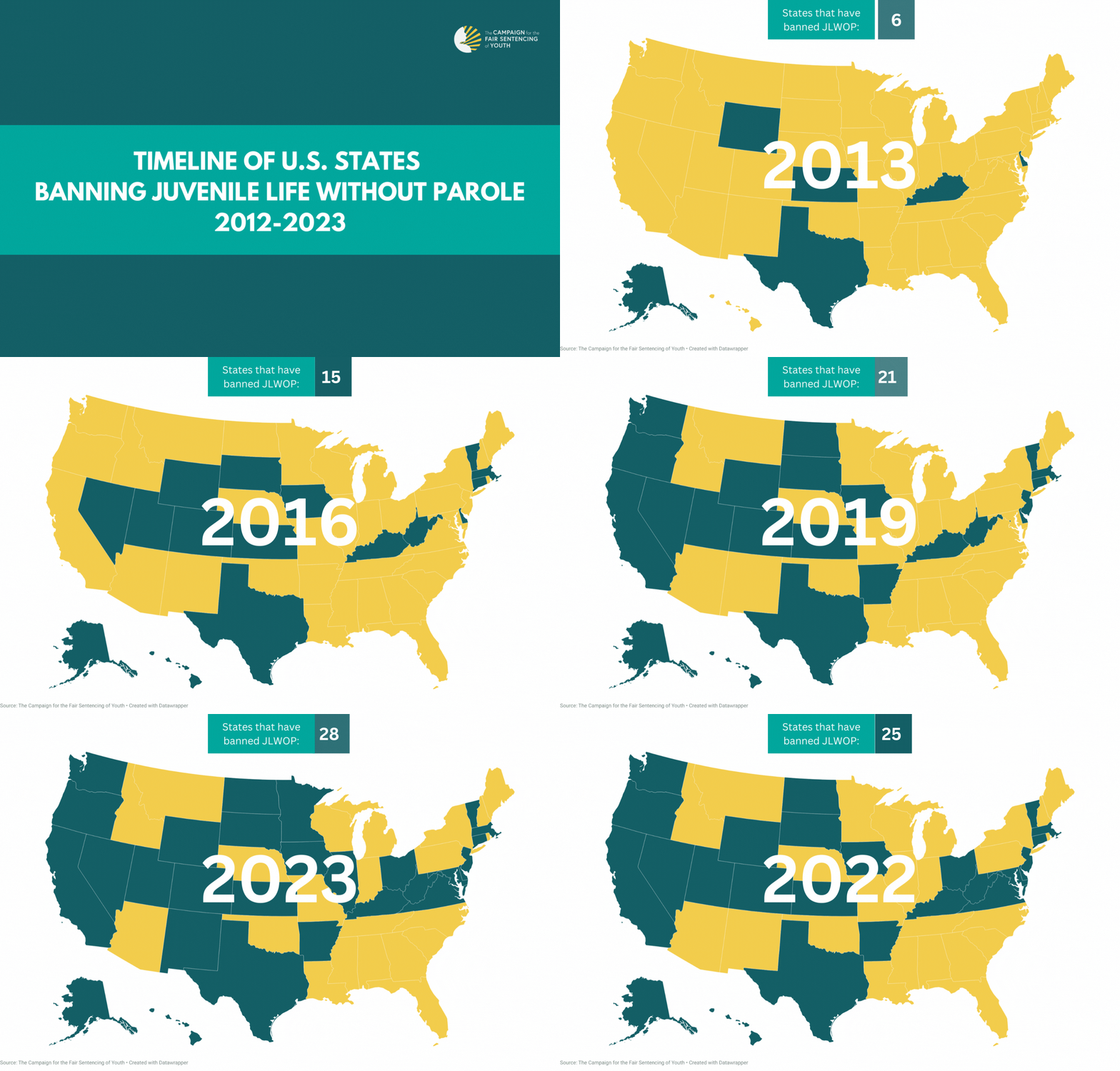
Minnesota becomes the 28th state to ban juvenile life without parole

May 19, 2023 – Today, in a critical advancement for the state of Minnesota and for the national youth sentencing reform movement, an omnibus public safety bill (SF 2909) was signed by Governor Walz after passing through the Minnesota Senate and House of Representatives. Among other reforms, SF 2909 prohibits children from being sentenced to life without the possibility of parole and grants resentencing and release eligibility to people who were under the age of 18 at the time of their offense. Minnesota is the 28th state in the country (in addition to the District of Columbia) to abolish this barbaric practice. Ninety-seven people in Minnesota are serving sentences of 15 or more years for offenses committed as children, and in most cases will now be eligible for a sentencing review. 

In 2012, only three states in total had banned juvenile life without parole (JLWOP). In 2023 alone, three states have already ended the practice of sentencing children to die in prison. As Illinois, New Mexico, and now Minnesota join the growing majority of state legislatures turning away from extreme sentencing, thirty-four states now either ban JLWOP or have no one serving the sentence.    


Through the leadership of bill sponsors and supporters, particularly Rep. Sandra Feist and Sen. Ron Latz, Minnesota has declared that we must never give up on hope for any child. “We’ve seen an incredible uptick in state legislatures banning life without parole for kids, and until now, Minnesota has been out of step with that national trend toward youth sentencing reform,” says Preston Shipp, the CFSY’s Senior Policy Counsel. “Children must be held accountable for their actions, but because they are fundamentally different from adults in their ability to assess risk and consequences, and their unique capacity for change, they should be held accountable in age-appropriate ways with a focus on rehabilitation and reintegration into society.”

“Many people serving extreme sentences as children will now have a chance to show the world who they’ve become, “ says Xavier McElrath-Bey, Co-Executive Director of the CFSY. “No child in Minnesota’s legal system will ever have to live without hope.”

—

For more information, or if you would like to arrange an interview, please contact Adam Kemerer at [email protected] | 412-728-2340.

The Campaign for the Fair Sentencing of Youth is a nonprofit that leads efforts to ban life-without-parole and other extreme sentences for children, and supports those incarcerated as children who are released after serving long sentences.

Press Release: New Mexico Abolishes Life Without Parole Sentences for Children - March 2023

FOR IMMEDIATE RELEASE: March 22, 2023
Media Contact: Adam Kemerer | [email protected] | 412-728-2340

NEW MEXICO ABOLISHES LIFE WITHOUT PAROLE SENTENCES FOR CHILDREN

The bill will grant parole eligibility to those New Mexicans who were handed extreme sentences under the age of 18 

March 22, 2023, Washington, DC  –  Banning life-without-parole sentences for children in New Mexico last week, Governor Michelle Lujan Grisham signed the No Life Sentences for Juveniles Act (SB 64) on Friday, March 17, 2023. This law makes New Mexico the 27th state (plus Washington DC) to end the use of these sentences for people younger than 18.

This is the latest in a national trend to reject the practice of sentencing children to die in prison. In 2012, the U.S. Supreme Court established in Miller v. Alabama that sentencing a child to life without the possibility of parole is unconstitutional in all but the rarest of circumstances. At the time of that decision, only three states banned this practice. In the last decade, the number of states has increased ninefold.

This law will affect at least 75 individuals as it ensures that all individuals sent to prison for serious crimes committed when they were under 18 years old will be eligible for parole hearings 15 to 25 years into their sentences, depending on the conviction.

Before reaching the Governor, the legislation passed the state’s House of Representatives and received bipartisan support in the Senate. The final language of the bill was the result of negotiations with a number of stakeholders, including the New Mexico District Attorney’s Association. These negotiated amendments provided a pathway for this proposed reform to become law. “This bill is a result of a lot of compromises, a lot of conversations between victims, victim advocates, the ACLU, defense attorneys, and all sides of this. I believe that this compromise bill really reflects where the science is on the teenage brain and I would urge you to pass this,” testified the First Judicial District Attorney Mary Carmack-Altwies in her individual capacity at a committee hearing.

Successful negotiations also resulted in former opposition lending their support for the reform. Sen. Ron Griggs (R-Alamogordo) opposed the bill in 2022 but was one of the Republican Senators who voted for it this session. “Any of us standing here today, we’re all probably lucky that when we were kids, we didn’t do something that put us in a bad spot,” Griggs said.

Other supporters of this reform include longtime advocates from the NM Coalition for the Fair Sentencing of Youth, ACLU New Mexico, FAMM, Bold Futures New Mexico, Lutheran Advocacy Ministry-NM, Americans for Prosperity, Southwest Organizing Project, and Sister Helen Prejean.

Co-Sponsor and State Senator Antoinette Sedillo Lopez celebrated the bill becoming law, affirming that “incarcerated individuals who made horrible mistakes as children are deserving of hope and the possibility of redemption.” Denali Wilson, a staff attorney at the ACLU-NM and the lead advocate for the bill added, “we are overjoyed that New Mexico has made this important choice to believe in redemption. So many of the people impacted by this bill have already been in prison for decades, many for longer than I have been alive. For them, today marks the first day of hope.”

The ACLU and CFSY are partnering to ensure those impacted by the law will have legal representation for their parole hearings. “We have partnered with advocates in New Mexico for many years, seeking the meaningful reform that Gov. Lujan Grisham signed into law last week,” says Xavier McElrath-Bey, co-executive director of the Campaign for the Fair Sentencing of Youth. “Many people serving extreme sentences as children will now have a chance to show the parole board and, hopefully, the world who they’ve become. We have had the great honor of witnessing many of the 950 former life-sentenced children become mentors and change-makers in their communities and do other positive things to live out their eternal apology for the harm they once caused. To them, a second chance doesn’t mean freedom from responsibility; it means finally being able to contribute to the much-needed healing in their communities.”


***

For more information, or if you would like to arrange an interview, please contact Adam Kemerer at [email protected] | 412-728-2340

The Campaign for the Fair Sentencing of Youth is a nonprofit that leads efforts to ban life-without-parole and other extreme sentences for children, and supports those incarcerated as children who are released after serving long sentences to lead and thrive.

Press Release: Illinois Abolishes Life Without Parole Sentences For Children - February 2023

MEDIA ALERT
Contact: Alissa Rivera
(312) 809-6992, Extension 103
[email protected]

ILLINOIS ABOLISHES LIFE WITHOUT PAROLE SENTENCES FOR CHILDREN; LEGISLATORS INTRODUCE BILL TO MAKE YOUTHFUL PAROLE RETROACTIVE


February 13, 2023 – Springfield, IL

Governor JB Pritzker signed Public Act 102-1128 (House Bill 1064) into law on Friday, February 10, abolishing life without the possibility of parole sentences for children in Illinois. This makes Illinois the 26th state (plus Washington D.C.) to end the use of these sentences for people younger than 18. Illinois’ law also makes our state a leader in sentencing reform by recognizing young people’s brain development and ensuring most people 18-20 are parole-eligible. Governor Pritzker signed the measure the same week legislators introduced a bill to make youthful parole retroactive.

“This has to be my proudest professional moment. Being a former ‘juvenile lifer’ and being part of an amazing team that pushed this legislation, it is so rewarding to know that legislators understand children can change and become productive members of society,” Restore Justice Program Director Wendell Robinson said.

Public Act 102-1128 builds on the 2019 Youthful Parole Law, which created the first new parole opportunities in Illinois since our state abolished parole in 1978. The most recent law extends parole review to young people sentenced to natural life in prison; this ensures no children 17 and younger can receive a life without parole sentence.

“Today, I am proud to be an Illinoisan. In Illinois, we care about our children. Recognizing that young people can grow and change recognizes their humanity; it is an act of mercy and kindness. Thank you Governor Pritzker and the Illinois legislators on both sides of the aisle that supported it,” said Julie Anderson, Restore Justice’s Outreach Director. Anderson’s son originally received a life without parole sentence for a youthful conviction.

Public Act 102-1128 passed with bipartisan support. In the House, Representatives Rita Mayfield (D-Waukegan) and Seth Lewis (R-Bartlett) sponsored the measure. “Even when a crime is particularly severe, it should be recognized that a legal minor with their whole life still ahead has the potential to be reformed,” Representative Mayfield said. “That’s why granting eligibility for a parole hearing after 40 years for those who are sentenced to life imprisonment before the age of 21 is the right thing to do. I recognize that victims and their families may have concerns, and I don’t blame them. However, in a nation like ours, prison should be a place where people have the opportunity to transform themselves and become better people and productive members of society. I believe that giving everyone a chance at redemption is a moral duty.”

Senate President Don Harmon (D-Oak Park) moved the measure through his chamber and also sponsored the 2019 Youthful Parole Law. “It’s a sliver of hope for an otherwise condemned person under 21 who maybe, just maybe, might redeem themself decades down the road and warrant consideration for a second chance at society,” President Harmon said after the bill passed through the Senate.

On the Senate floor, Senator Donald DeWitte (R-St. Charles) spoke forcefully in favor of redemption. “I consider myself a law-and-order Republican, but I also believe in rehabilitation. I believe there are some people who make extremely poor decisions in the very early portions of their lives who deserve consideration once they have met benchmarks and shown they are prepared to become contributing citizens after they have served their debt to society. For these people, we need to offer them hope and let them know we recognize that people can redeem themselves,” Senator DeWitte said.

“This new law builds on the national momentum to ensure no children or young adults are sentenced to die in prison without the opportunity to return home. Everyone deserves the opportunity for grace and redemption. No child should spend their life in prison,” Restore Justice Policy Director Rev. Lindsey Hammond said.

Also last week, now-Senator Seth Lewis introduced Senate Bill 2073. This bill would make the 2019 and 2023 youthful parole laws retroactive. If signed into law, SB 2073 would allow 523 people who are currently incarcerated the opportunity to immediately seek parole consideration. In total, 3,253 people (including the above 523) currently incarcerated people would be eligible for parole consideration at some future point in time.

***

Restore Justice, which comprises Restore Justice Foundation and Restore Justice Illinois, works to address issues faced by those serving life or de-facto life sentences, their families, and their communities. Founded in 2015 by a dedicated group of advocates that included the late former Congressman, Federal Judge, and White House Counsel Abner Mikva, Restore Justice trains and supports advocates, conducts research, nurtures partnerships, and develops policy solutions that will roll back ineffective, punishment-based policies of the past, replacing them with compassionate, smart, and safe policies for the future.

Campaign for the Fair Sentencing of Youth (CFSY) is a national nonprofit that leads efforts to ban life without parole and other extreme sentences for children. The CFSY is an equity-driven organization that explicitly works to dismantle the racial disparities, social injustices, and residual harms caused by the legal system. Through partnerships with advocacy organizations, businesses, and other stakeholders, the CFSY supports survivors of youth violence, those incarcerated as children who are still serving or have been released, and their respective families and communities.
Press Release: Henry Montgomery has been granted parole - November 2021

FOR IMMEDIATE RELEASE: November 17, 2021
Media Contact: Adam Kemerer | [email protected] | 412-728-2340

Henry Montgomery has been granted parole

Henry Montgomery, the petitioner in the 2016 landmark U.S. Supreme Court decision Montgomery v. Louisiana, was finally granted parole today more than five years after the Court ruled in his favor. 

Mr. Montgomery is 75 years old and has been in prison for over 57 years. He was convicted of a homicide in 1963 in East Baton Rouge Parish when he was just 17 years old.

“The decision to grant Mr. Montgomery parole today is long overdue,” says Jody Kent Lavy, co-executive director of the Campaign for the Fair Sentencing of Youth. “It’s a grave injustice that he has served over 57 years in prison for a crime he committed as a teenager, despite evidence he was rehabilitated long ago. We are the only country in the world that condemns children — disproportionately children of color — to die in prison, and we must recognize that this fight is not over.”

Since Montgomery v. Louisiana was decided, more than 800 people who were once sentenced to life without parole as children have been released from prison. Today, 31 states and the District of Columbia either ban life without parole for children or have no one serving the sentence.

If you have additional questions, please reach out to Adam Kemerer at [email protected]

Press Release: Virginia bans life without parole for children - February 2020

FOR IMMEDIATE RELEASE: February 24th, 2020
Media Contact: Karmah Elmusa | [email protected] | 202-289-4677 ext. 113

VIRGINIA GOVERNOR SIGNS HB35 INTO LAW, GIVING PAROLE
ELIGIBILITY TO CHILDREN AFTER 20 YEARS IN PRISON
The Commonwealth joins 22 other states and DC in banning life without parole for
people under 18 and complying with Supreme Court rulings on youth sentencing

February 24th, 2020, Washington, DC –– Today, in a critical advancement for the
Commonwealth, Governor Ralph Northam signed HB35 into law, which passed handily through
both legislative chambers last week. HB35 grants parole eligibility after 20 years of incarceration
to all people in Virginia who were under the age of 18 at the time of their offense. It therefore
automatically bans sentencing children to life without the possibility of parole, making Virginia
the 23rd state in the country (in addition to the District of Columbia) to abolish this barbaric
practice.

“Those of us who have loved ones serving life sentences they were given as children in Virginia
have been working on this for years,” says Jana White, of the Virginia Coalition for the Fair
Sentencing of Youth. “There have been major obstacles and setbacks along the way, but we
never gave up and this bill signing marks the beginning of a more just era for the children of this
state. Our family members are filled with newfound hope today, which is something they haven’t
experienced in a long time.”

The bill — which was sponsored by Delegate Joe Lindsey — will impact over 700 currently
incarcerated individuals who were sentenced as children in adult court in Virginia by offering
them review, marking a major shift in the way the Commonwealth has dealt with its sizable
population of youth sentenced to extreme terms. Until now, it has been an outlier in its blatant
noncompliance with multiple Supreme Court rulings that have made it unconstitutional to
sentence a child to life without parole in almost all cases.

“We’ve seen an incredible uptick in state legislatures banning life without parole for kids, and
until now, Virginia has been woefully out of step with that national trend toward youth sentencing
reform, even when compared to states like Arkansas and West Virginia” says Jody Kent Lavy,
executive director of the Campaign for the Fair Sentencing of Youth. “Children must be held
accountable for their actions, and because they are fundamentally different from adults in their
ability to assess risk and consequences, and their unique capacity for change, they should be
held accountable in age-appropriate ways with a focus on rehabilitation and reintegration into
society.”

“This is the eighth year that I have addressed this issue in the legislature. While there are many
individuals who remain dangerous, there are many more who have made strong efforts to turn
their lives around while incarcerated and are worth the Parole Board taking a look at whether
they can be restored to society,” says Senator Dave Marsden, who sponsored an identical bill in
the Senate. “We are a nation of second chances and those who are incarcerated for long
periods of time when they are juveniles are especially deserving of that look. This law in Virginia
is consistent with the Graham , Miller , and Montgomery rulings at the U.S. Supreme Court and I
am grateful that my colleagues in the legislature have now supported this effort at providing
individuals with a measure of justice that has been recognized in so many other states.”

***

For more information, or if you would like to speak with Jody Kent Lavy or someone directly
impacted by the law, please contact Karmah Elmusa at [email protected] |
202-289-4677 ext. 113.

The Campaign for the Fair Sentencing of Youth is a nonprofit that leads efforts to ban
life-without-parole and other extreme sentences for children, and supports those incarcerated as
children who are released after serving long sentences.

Press Release: Oklahoma Legislature Passes Inhumane and Unconstitutional Youth Sentencing Bill, Could Become National Outlier - May 2018

FOR IMMEDIATE RELEASE: May 2, 2018

Media Contact: Karmah Elmusa | [email protected] | 202-289-4677 ext. 113

OKLAHOMA LEGISLATURE PASSES INHUMANE & UNCONSTITUTIONAL YOUTH SENTENCING BILL, COULD BECOME NATIONAL OUTLIER

Law would be the worst among states that have passed legislation following U.S. Supreme Court mandate in Montgomery v. Louisiana

May 2, 2018, Washington, DC –– Today, in a misguided effort to comply with recent U.S. Supreme Court decisions on sentencing children to life without parole, the Oklahoma legislature passed SB 1221. If signed into law, this bill would make it easier for children in Oklahoma to receive draconian life-without-parole sentences, scaling back protections that were put in place by the Oklahoma Criminal Court of Appeals – including protections that require a jury to find that a child is beyond rehabilitation before such a sentence could be imposed.

Oklahoma’s neighbors – including Texas, Arkansas, Kansas, and Colorado – have eliminated life-without-parole sentences for children. In making SB 1221 law, Oklahoma would not only be out of step with the region, but would have the worst law of this kind in the country and would become a national outlier when it comes to how the state treats children who are convicted of serious crimes.

“This bill flies directly in the face of the momentum we’ve seen around the country to end the barbaric practice of sentencing children to die in prison – a practice only seen in the United States. Not only has the Supreme Court found it unconstitutional in almost all cases, but the number of states to ban life without parole has quadrupled in just the last six years, with traditionally conservative states leading the way,” says Jody Kent Lavy, executive director of The Campaign for the Fair Sentencing of Youth. “Science has shown us that children are different than adults. Their brains are not as developed, and just as they do not vote or serve in the military, they are not deserving of the same punishments. We ask Governor Fallin to veto this bill immediately, lest her state become a national aberration in its treatment of the most vulnerable among us — our children.”

Under SB 1221, children would lose the right to jury sentencing, while adults who commit the same crimes would still have that right. In other words, if made law, the bill would ensure that youth offenders in Oklahoma are treated worse than their adult counterparts. SB 1221 also raises serious constitutional concerns and will likely tie up Oklahoma Courts for years.

Finally, SB 1221 includes a 14-page amendment that was never vetted before any legislative committee in Oklahoma and was drafted wholly by the District Attorneys Council without input from judges, child advocates, or defense attorneys in the state. Oklahoma should be as thoughtful as its neighbors when crafting policies that will have a significant impact on children in the state, especially one that may take away their current constitutional rights.

For more information, or if you would like to speak with Jody Kent Lavy or advocacy director James Dold, please contact Karmah Elmusa at [email protected] | 202-289-4677 ext. 113.

***

The Campaign for the Fair Sentencing of Youth is a national coalition that leads, coordinates, develops and supports efforts to implement fair and age-appropriate sentences for youth.

Press Release: North Dakota bans life-without-parole prison sentences for children - April 2017

Bismarck, North Dakota, April 20, 2017 – North Dakota Governor Burgum, (R), has signed into law HB 1195, making North Dakota the 19th state to ban these death-in-prison sentences for children. The sentences also are not allowed in the District of Columbia.


HB 1195 ensures that no child in North Dakota will be sentenced to die in prison without hope of a second chance. The bill provides individuals who were convicted of serious crimes as children the opportunity to petition the court for judicial sentencing review to demonstrate they are deserving of a second chance after they have served 20 years.  Staff from the Campaign for the Fair Sentencing of Youth (CFSY) worked closely with State Representative Klemin (R), the bill’s sponsor, and other legislators to ensure HB1195 passed the North Dakota state legislature unanimously with broad bi-partisan support.


“HB 1195 is about hope, redemption, and holding our children accountable for serious crimes they commit in more fair and age-appropriate ways, while protecting public safety,” said Representative Lawrence R. Klemin, (R-Bismarck).  “This bill reflects our understanding that even children who commit serious crimes are capable of change.  I introduced this bill to give hope to those children who do change, so that they may have the opportunity to demonstrate to a judge that they are deserving of a second chance.”


Influenced by recent U.S. Supreme Court decisions grounded in adolescent development research holding that children are “constitutionally different” from adults and should not be subject to the country’s harshest penalties, the nation has increasingly moved away from life-without-parole sentences for children. In five years, the number of states that ban sentences of life in prison without the possibility of release for children has nearly quadrupled to a total of 19 plus the District of Columbia. This includes North Dakota’s neighboring states of Montana and Wyoming. An additional four states ban life-without-parole sentences for children in most cases. North Dakota and Arkansas both passed legislation on the issue this year.


“This victory in North Dakota reflects the recent groundswell of support for abolishing death-in-prison sentences for children,” said Jody Kent Lavy, executive director at the Campaign for the Fair Sentencing of Youth. “Most importantly, it brings hope to those told as children they were worth nothing more than dying in prison.”


Research by the Sentencing Project has shown that most children sentenced to life without parole have suffered extreme trauma and abuse. More than 80 percent of these youth witnessed violence in their homes and neighborhoods on a regular basis. More than 50 percent of boys and 80 percent of girls were physically abused; More than 20 percent of boys and 77 percent of girls were sexually abused.


“Like many of the people serving these sentences, I experienced severe abuse and neglect as a child, and I eventually joined a gang for a sense of family,” said Xavier McElrath-Bey, who was incarcerated as a child and now serves as senior advisor and national advocate at CFSY.  “At age 13, I was responsible for the tragic death of another child.  I spent 13 years in prison.  I learned my lesson and grew into a remorseful adult. Today, at age 41, I am living proof that no child is beyond redemption, which is why youth should never be sentenced to die in prison.”


“Every day within the Department of Corrections and Rehabilitation we see people who turn their lives around in prison, in spite of the obstacle of incarceration,” said Leann Bertsch, director of the North Dakota Department of Corrections and Rehabilitation. “Kids can and do grow up; and as they develop, they change. None of us are the same at 50 as we were at 16. Providing the possibility for judicial sentencing review decreases the likelihood of continued violent behavior behind bars and provides incentives to engage in meaningful rehabilitative programs so as to be considered more favorably by the sentencing court.”


In addition to giving people sentenced to life without parole the ability to have their sentences reviewed, the North Dakota bill will allow any child sentenced to more than 20 years the opportunity for a possible sentence reduction. As a result, all North Dakota children who commit crimes will now have the opportunity to prove their capacity for change and that they are deserving to re-enter and live in free society.


Press Release: Iowa Supreme Court Bans Life-Without-Parole Sentences for Children - May 2016

For Immediate Release: May 27, 2016

Iowa Supreme Court Bans Life-Without-Parole Sentences for Children

(Washington, DC) The Iowa Supreme Court today issued a historic ruling in State v. Sweet that life-without-parole sentences for all children 17 or younger violate the Iowa Constitution. Iowa joins a growing number of states that have outlawed this death-in-prison sentence for youth 17 and younger – a sentence only the United States imposes. The ruling builds upon a swell of opinions from the United States Supreme Court finding that youth must be treated less harshly than adults because of their unique characteristics as children.

Today’s ruling invalidates the life-without-parole sentences of dozens in Iowa sentenced for crimes committed as children.

“The Iowa Supreme Court has today enshrined in the law a protection too easily revoked from children who commit serious crimes: a respect for their child status,” said Jody Kent Lavy, Director & National Coordinator of the Campaign for the Fair Sentencing of Youth, a nonprofit that leads a national movement to end life without parole for youth. “The Court has respected what science and common sense demand: that children, because of their differences from adults, be treated less harshly in the eyes of the law, and never discarded forever with no hope of review.”

Today’s decision does not guarantee parole; it requires that the state never impose a sentence on children 17 or younger that condemns them to spend the rest of their lives in prison without any chances at review. It used as a deciding factor the difficulty a sentencer would have in determining whether a child’s crime reflects “permanent incorrigibility,” as required by the U.S. Supreme Court in its 2016 ruling in Montgomery v. Louisiana.

“[W]e are asking the sentencer to do the impossible, namely, to determine whether the offender is ‘irretrievably corrupt’ at a time when even trained professionals with years of clinical experience would not attempt to make such a determination,” the Iowa Supreme Court reasoned.

It now falls to lower courts in Iowa to implement the decision fairly and replace any unconstitutional life-without-parole sentences with alternatives that afford meaningful opportunities for release based on the mitigating factors of youth.

In last four years, the number of states that ban juvenile life without parole have more than tripled. Among them are Nevada, West Virginia, and Connecticut.

Read the decision here.

Press Release: Catholic Bishops call for end to life without parole for youth - January 2013

The U.S. Conference of Catholic Bishops today announced that it has endorsed the principles of the Campaign for the Fair Sentencing of Youth. The USCCB is ” is an assembly of the hierarchy of the United States and the U.S. Virgin Islands who jointly exercise certain pastoral functions on behalf of the Christian faithful of the United States.” It is comprised of 454 active and retired Catholic bishops who lead Dioceses and Archdioceses throughout the country.

The full text of the news release follows.

DATE:           January 30, 2013

FOR IMMEDIATE RELEASE


BISHOPS’ COMMITTEE JOINS CALL TO END LIFE SENTENCES WITHOUT PAROLE FOR CHILDREN


WASHINGTON – A committee of the U.S. Conference of Catholic Bishops (USCCB) has endorsed the principles of a national campaign to end the practice of sentencing people under the age of 18 to life in prison without the possibility of parole. The USCCB Committee on Domestic Justice and Human Development agreed to endorse the Statement of Principles for the Fair Sentencing of Youth at their December 2012 meeting.

“While there is no question that violent and dangerous youth need to be confined for their safety and that of society, the USCCB does not support provisions that treat children as though they are equal to adults in their moral and cognitive development,” said Bishop Stephen E. Blaire of Stockton, California, chairman of the committee. “Life sentences without parole eliminate the opportunity for rehabilitation or second chances.”

In their 2000 document, “Responsibility, Rehabilitation, and Restoration: A Catholic Perspective on Crime and Criminal Justice,” the bishops wrote, “Placing children in adult jail is a sign of failure, not a solution.”

More than 100 organizations have endorsed the Statement of Principles of the Campaign for the Fair Sentencing of Youth, including a diverse array of faith-based organizations such as the Evangelical Lutheran Church of America, the General Synod of the United Church of Christ, the United Methodist Church, the Muslim Public Affairs Council and the Jewish Council on Urban Affairs. Supporters also include groups representing law enforcement officials, victims’ families, mental health experts, parents, teachers and child welfare advocates.

“We welcome the opportunity to partner with USCCB, a national leader defending the rights of our most vulnerable,” said Jody Kent Lavy, director of the Campaign for the Fair Sentencing of Youth. “We support the Church’s efforts to promote the greater good by ensuring that children are held accountable for the harm that they have caused in age-appropriate ways that uphold their human dignity and focus on rehabilitation and reintegration into society.”

The federal government and 38 states allow youth convicted of a crime to be sentenced to life without the possibility of parole. Currently, over 2,500 youth are serving life sentences without the possibility of parole. African American youth are sentenced to life without parole as children at a per capita rate that is 10 times that of white youth convicted of the same crimes. The United States is the only country that imposes this sentence upon children.