

By Jose Burgos, Policy Advocate at the Campaign for the Fair Sentencing of Youth • June 25, 2026
I will never forget June 25, 2012.
That morning, news of the U.S. Supreme Court’s decision in Miller v. Alabama began spreading through the prison. The Court had ruled that mandatory life without parole sentences for children were unconstitutional. For the first time in decades, thousands of people who had entered prison as children heard something they never thought they would hear: there might be a path home.
I first learned of the ruling as it flashed across the CNN news ticker. As word spread throughout the prison, an energy unlike anything I had ever experienced began to take hold. Men who had spent decades incarcerated since childhood were suddenly confronted with a possibility they had long buried deep inside themselves the possibility of freedom. The possibility of seeing their families again. The possibility of reclaiming a life that had been lost so many years before.
Just hours after the ruling came down, a corrections officer called me to the officer’s station and informed me that I was needed at the control center for a media interview. At the time, MIRS News was already in the process of writing a story about me and my experience serving life without parole for a crime committed as a child. Because of the Court’s decision, they wanted to include my reaction to the ruling before publishing the article.
I was escorted to a private room where a phone sat waiting on a small desk. The officer instructed me to answer when it rang.
Seconds later, the phone rang.
“Mr. Burgos?” a voice asked.
The reporter introduced herself and explained the reason for the sudden interview request, though the reason was obvious. The story she had been writing was about this very issue.
Her first question was simple:
“How do you feel about the ruling?”
In that instant, the first thing that came to my mind was not myself.
It was my victims.
It was their family.
I wondered how they might be feeling in that moment.
I did not want my response to come across as a celebration blind to their experiences. This was not a birthday party. We were not blowing out candles. There were no balloons. We certainly were not popping bottles of champagne.
Yes, there was joy in the thought that one day I might regain my freedom, reconnect with my family, and have a second chance at life. But I also understood that there were countless victims and victims’ families across this country who, no matter how much time had passed, were still carrying the pain and loss of a loved one.
I wanted to be respectful of that reality.
So I shared those thoughts with the reporter. A few more questions followed, and within minutes the interview was over.
When I returned to the housing unit, the atmosphere had changed. Everywhere I looked, people were talking about Miller.
I walked toward the phones to call my family and share the news. But when I got there, I quickly realized something remarkable: every phone on every floor was occupied by someone serving a juvenile life sentence.
Every single one.
Men who had spent twenty, thirty, and sometimes forty years in prison were calling home. They were speaking to mothers, fathers, siblings, spouses, children, and friends who had waited decades for a moment like this. Across the prison, conversations filled with tears, laughter, disbelief, and hope were taking place all at once.
For the rest of that day, hope seemed to hang in the air.
You could feel it in the yard.
You could hear it in the chow hall.
It echoed through the gym and even into the visiting room.
Wherever you went, people were talking about the ruling and what it might mean.
For so many of us, Miller v. Alabama represented more than a court decision. It represented recognition of something we had been trying to tell the world for years that children are different, that they are capable of growth and change, and that no child’s worst mistake should forever define who they become.
I will never forget that day.
For thousands of people sentenced to die in prison for crimes committed as children, June 25, 2012, became the day hope returned.
It became a beacon of light.
And for many of us, including myself, that light ultimately led us home.
As more of my friends and colleagues have come home over the years, I’ve realized that I wasn’t the only one whose first instinct was to look toward the people we had harmed. I wasn’t the only one who wondered if they were okay.
In the wake of Miller, many survivors did something I once thought impossible: some walked into our parole hearings and courageously advocated for our capacity to change. Some spoke to the media about the injustices they felt when the children who caused them harm were sentenced to die behind bars. Others worked with us formerly incarcerated youth to build organizations in response to youth harm.
Today, seeing survivors and formerly incarcerated people sitting side-by-side to care for our communities gives me a much more profound hope than what I felt watching that news ticker on June 25, 2012; because now I’ve also witnessed the healing that many survivors and formerly incarcerated youth have experienced together as a result, promising a more restorative path forward for our youth justice system.
Fourteen years later, I am assured, the impact of Miller is worth celebrating.
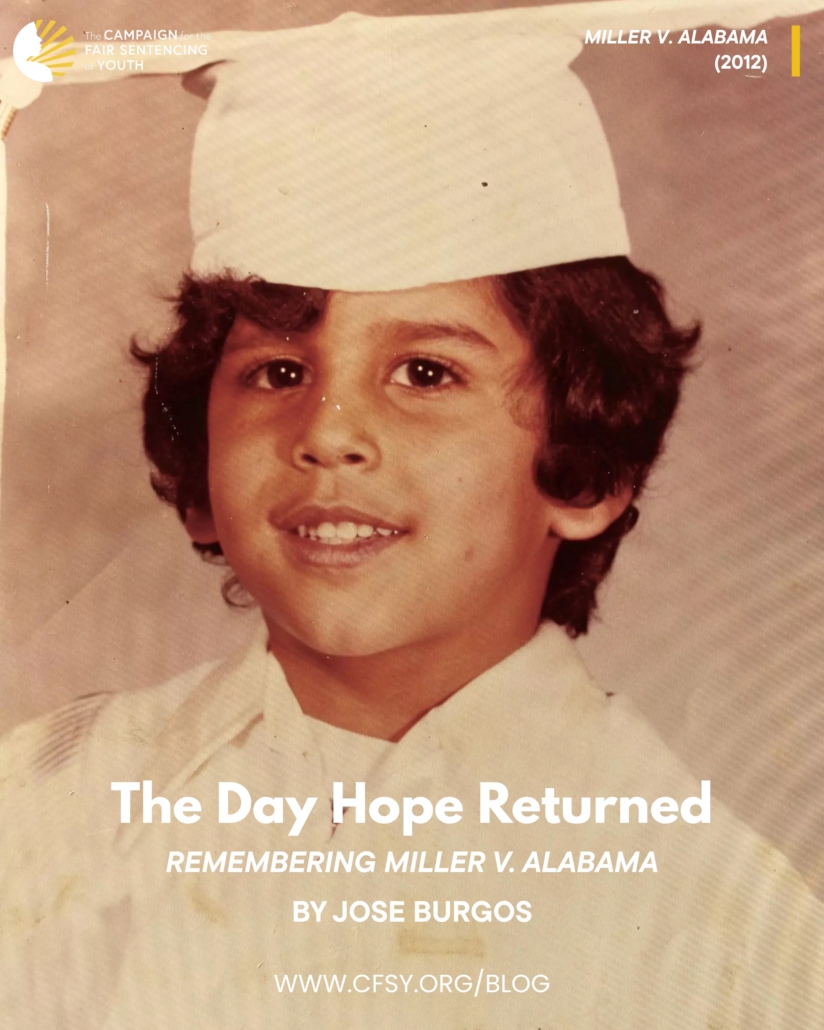
Jose Burgos was sentenced to life without parole in Michigan for an offense he committed at 16 years old. After 27 years of incarceration, he was resentenced and released, becoming a reentry specialist, a member of the Incarcerated Children’s Advocacy Network (ICAN), and now Policy Advocate at the Campaign for the Fair Sentencing of Youth (CFSY).